KICK.
Scaling Soccer Engagement via Decentralized Community Tools
Company
U.S. Soccer × GT MS-HCI
My Role
Lead Product Designer (Team of 4)
Tools
Figma · Gemini
Timeline
Aug 2025 – Dec 2025
Description
Democratizing grassroots soccer by replacing coordination friction with decentralized discoverability and community-led organization.
Context
Achieved a System Usability Scale (SUS) score of 83.75 on core tasks. We rejected the industry standard 'ticket sales' model in favor of a decentralized social model that celebrates the sport's organic nature, unifying the 'patchwork' of isolated sub-communities. The project was handed off to U.S. Soccer for development.
The Disconnect: Organic Chaos vs. Pay-to-Play
Pickup is among the most accessible way of engaging in soccer. Through interviews with 13 active players and organizers, we uncovered that the 'freedom' of pickup comes at a high cost: Admin Fatigue. Players are stuck manually chasing RSVPs, managing waitlists in Notes apps, and answering the same logistics questions daily. As one interviewee put it, 'Some don't show up and other brings a bunch extra guest… it's a mess.'
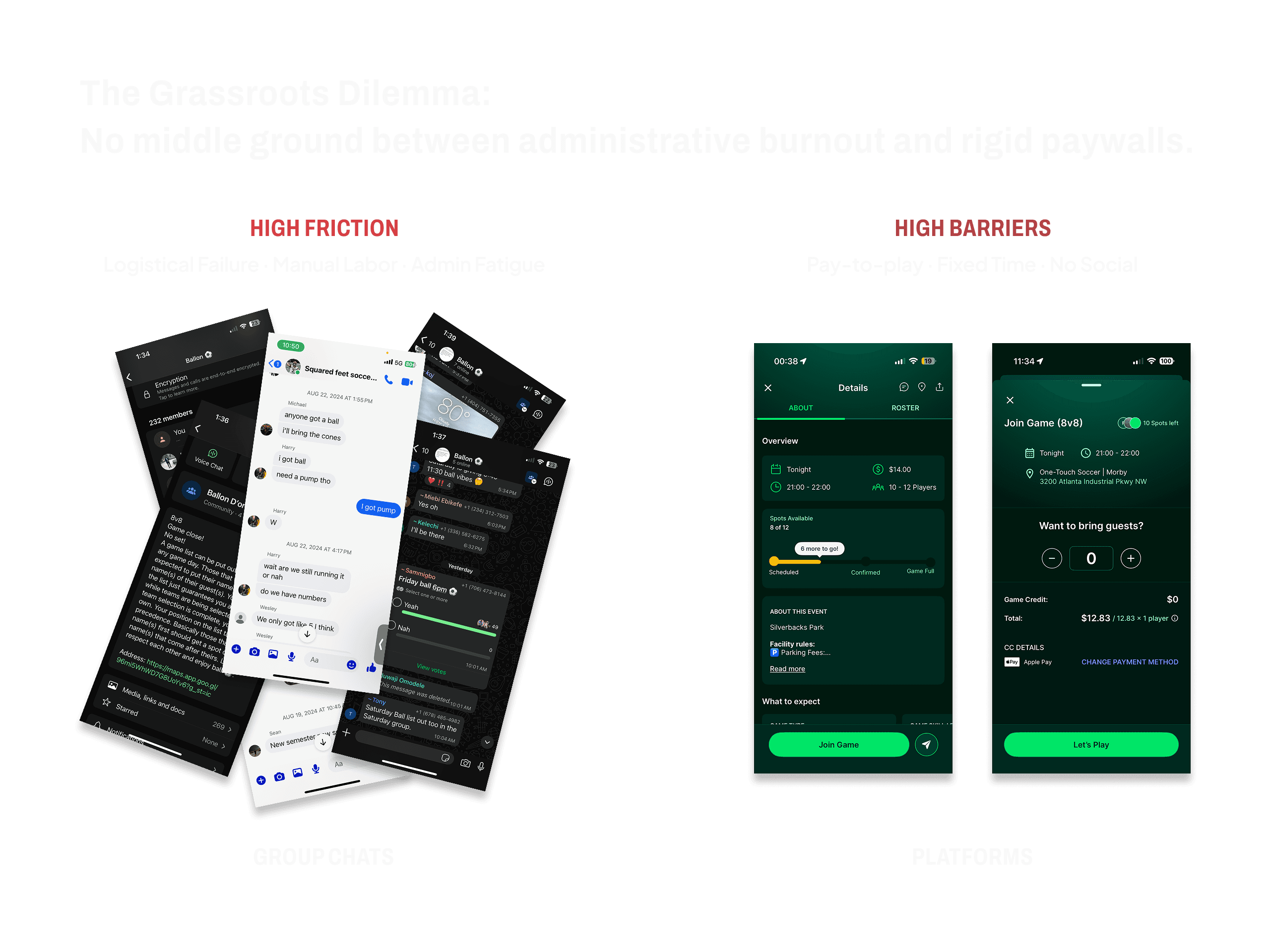
On the other end, we benchmarked leading competitors (like Plei and OpenSports) and found a rigid 'Ticket Sales' model. These platforms treat players as passive consumers. Users cannot propose a time or organize a match. It's buying a slot for a pre-set game. A community alternative is called for: one that shifts organizing power from the platform back to the players.
Plot Twist 1:
Eliminating Survey Fatigue via Automation
Scheduling represents the biggest friction point in pickup soccer, yet it is unavoidable for a community model. Initially, we tried to solve this by benchmarking tools like LettuceMeet, requiring users to fill out a time-availability grid for every single game proposal. Testing revealed this was a failure: it just replaced 'texting fatigue' with 'survey fatigue.' While providing maximal flexibility, users rejected the burden of repetitive data entry week after week.
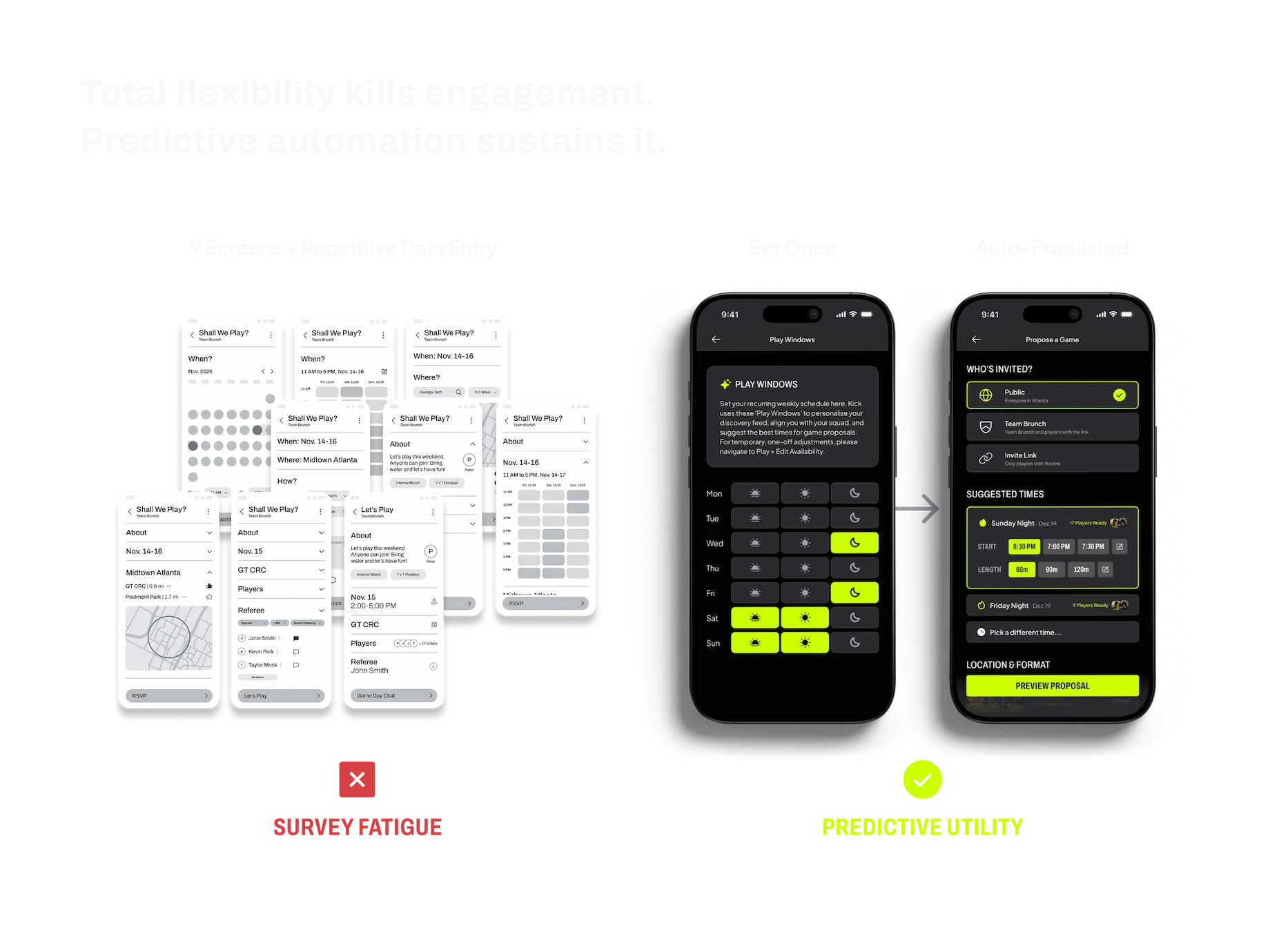
We went back to our research data and discovered a critical pattern: most players operate on consistent schedules interspersed with rare one-off opportunities. So instead of asking for availability per game, we built Play Windows, a system-level feature where users define their recurring slots once. The app algorithmically overlays these windows to automatically suggest the optimal kickoff time, turning a manual chore into an automated utility.
Plot Twist 2:
Removing Competition to Restore Connection
In early iterations, we designed a competitive structure with score reporting and achievement systems. However, Heuristic Evaluations and Think Aloud Sessions demonstrated that this structure was toxic to retention. The friction of verifying scores and assigning referees produced operational challenges that slowed players down rather than motivating them.
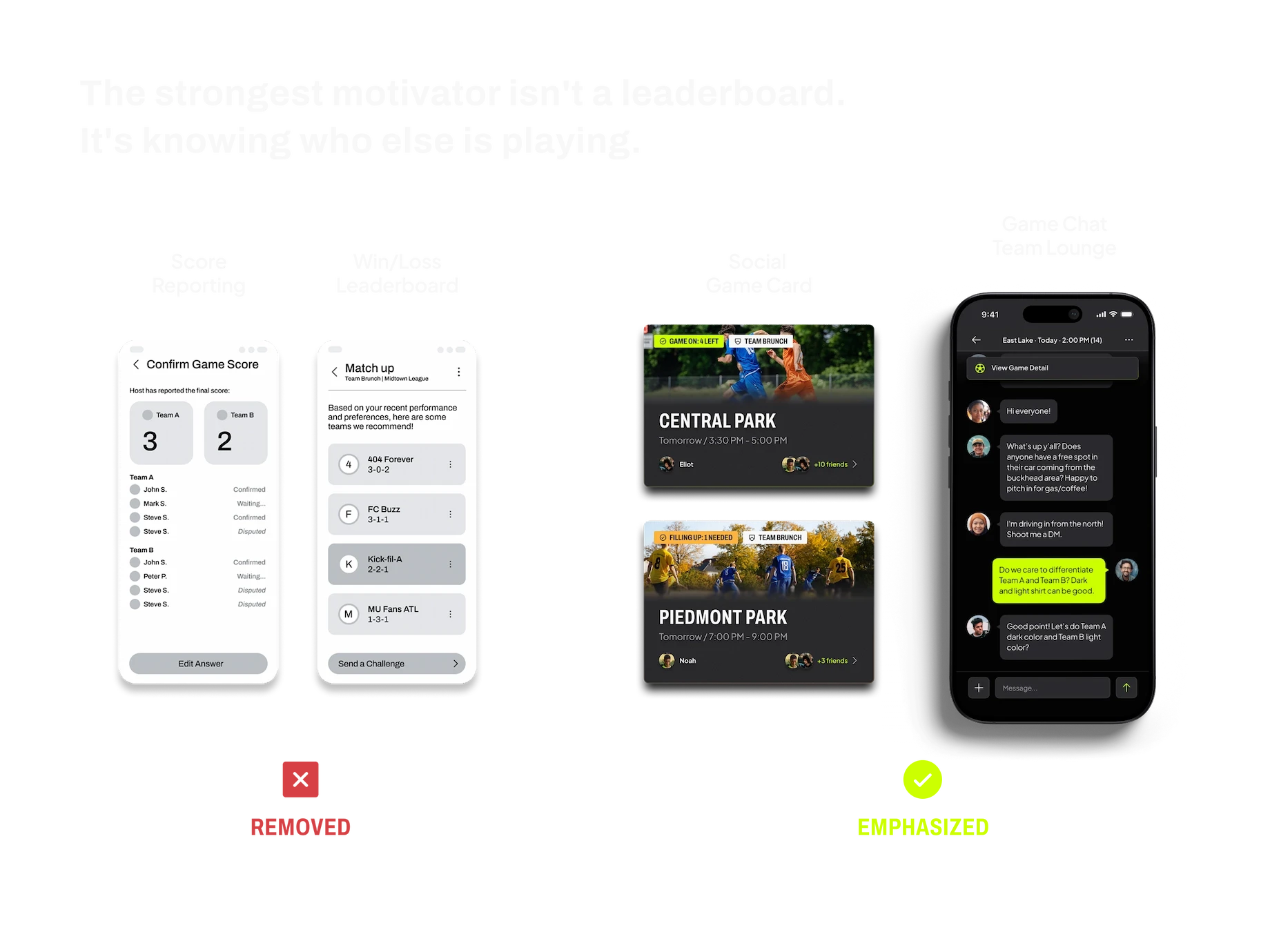
"Who's in the game?" surfaced as the single most critical factor for user decision-making. We stripped out the competitive features to double down on Social Cohesion. We introduced Adaptive Game Cards that instantly highlight friends, and built Team Lounges and Game Day Chat to facilitate connection beyond logistics. By removing the pressure to win, Kick is optimized for the true core of pickup: belonging.
The Outcome: A Self-Sustaining Pickup Soccer Platform
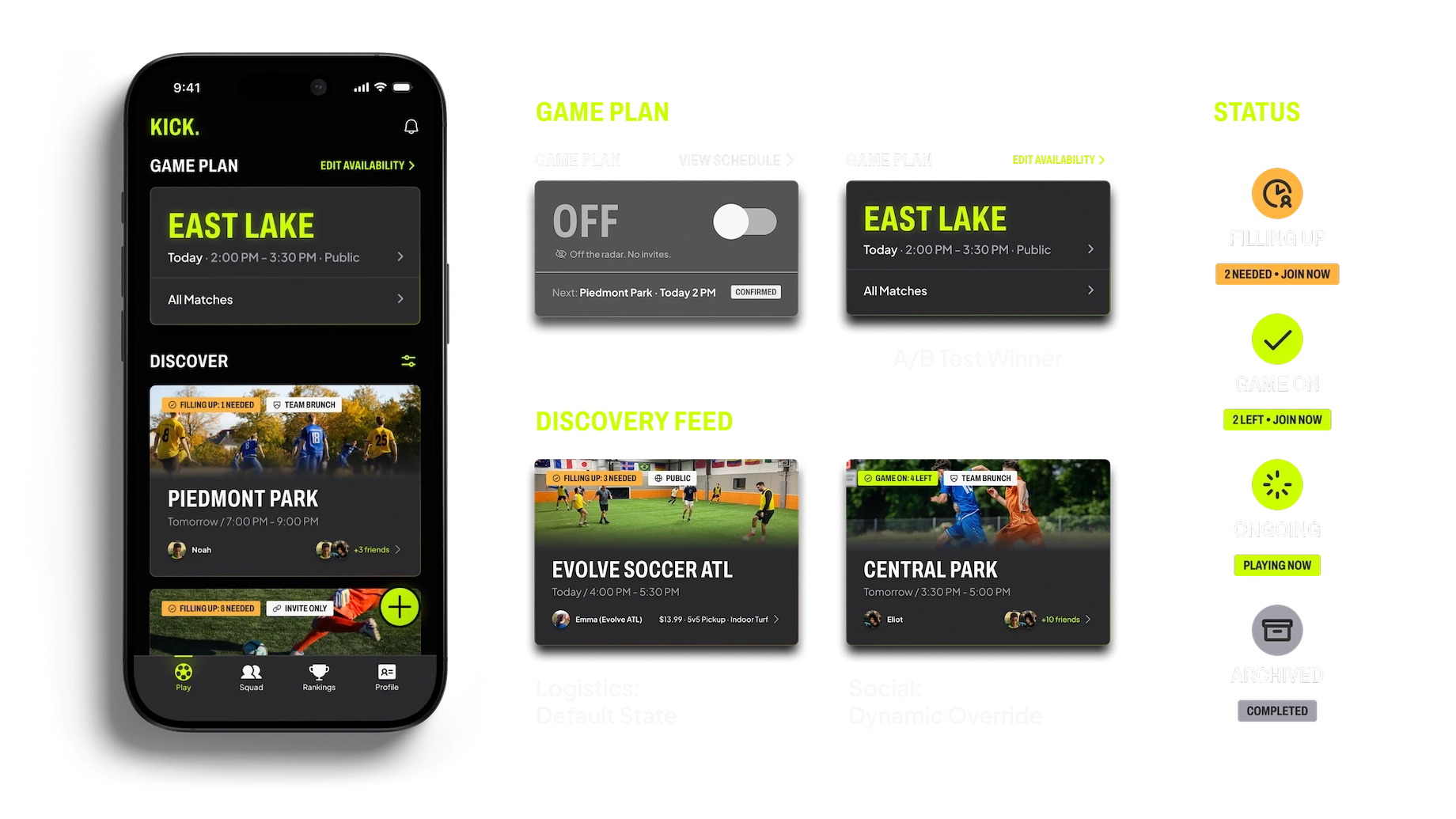
Dashboard: Balancing Orientation & Opportunity
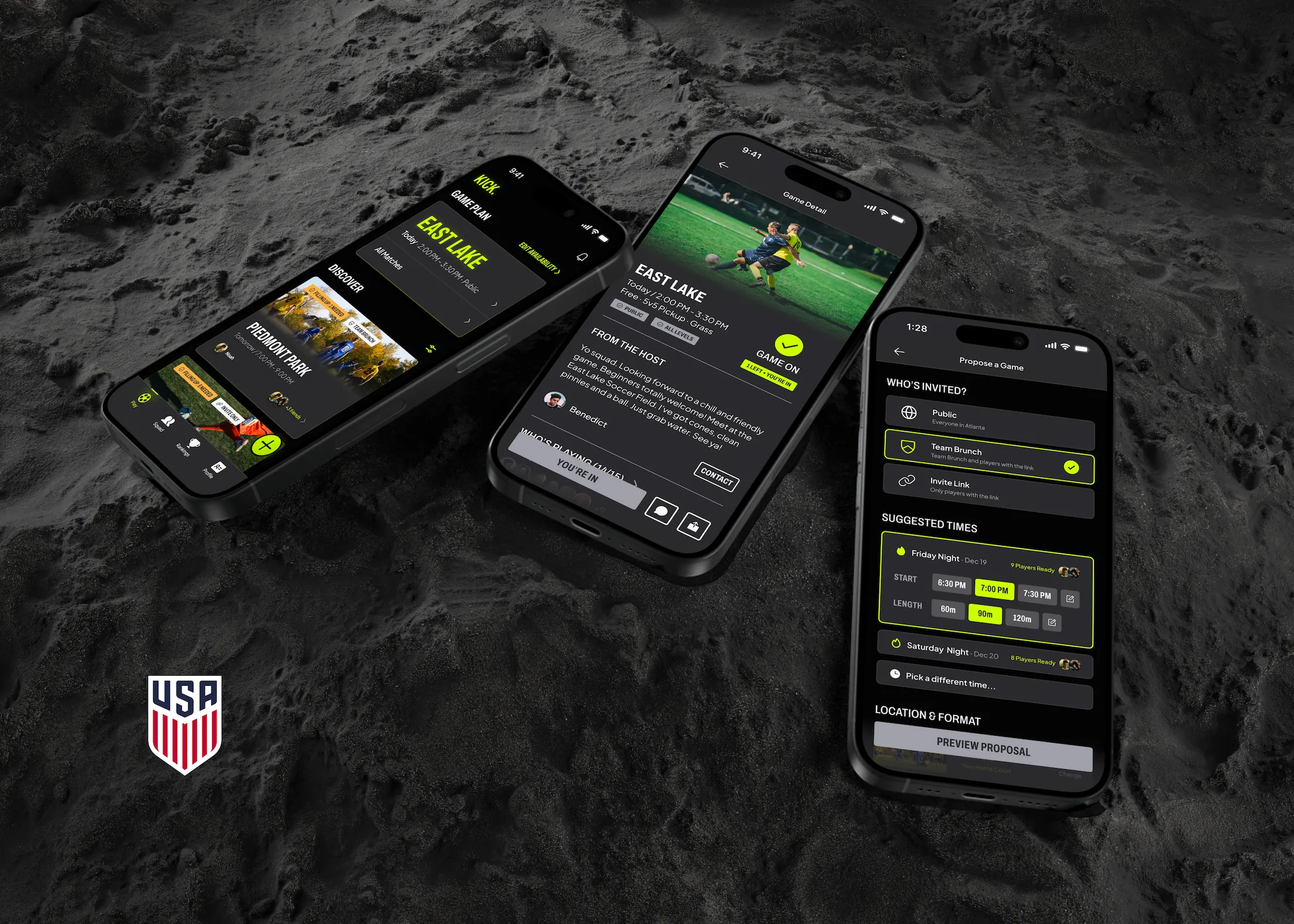
Players enter the app with two immediate questions: 'Where do I need to be?' and 'Where can I play?' We structured the landing page to answer both instantly. The Game Plan widget anchors the top with urgent 'Next Game' details, a hierarchy validated by A/B testing. Below, game cards expose key heuristics, allowing players to scan and qualify opportunities instantly without digging through menus.
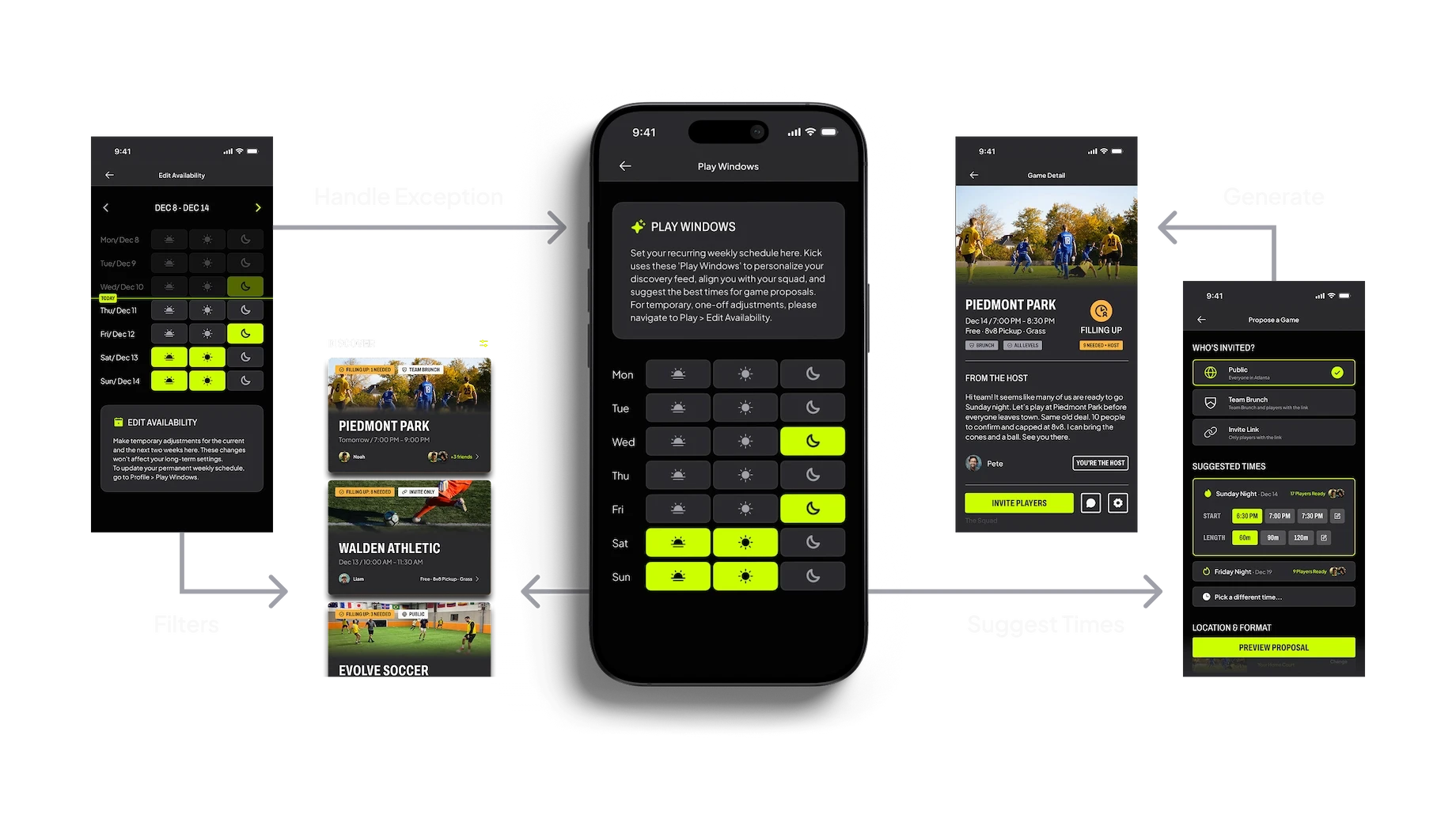
Scheduling Loop: Automating Routine & Exceptions
Manual scheduling fails by treating every week like a blank slate. We designed a system that separates Routine (Play Windows) from Exceptions (Edit Availability). This recurring baseline acts as the system's source of truth, driving the algorithm to speed up game creation by auto-suggesting optimal times and filter the Discovery Feed. The result is a platform where every proposal is grounded in availability, ensuring games actually happen.
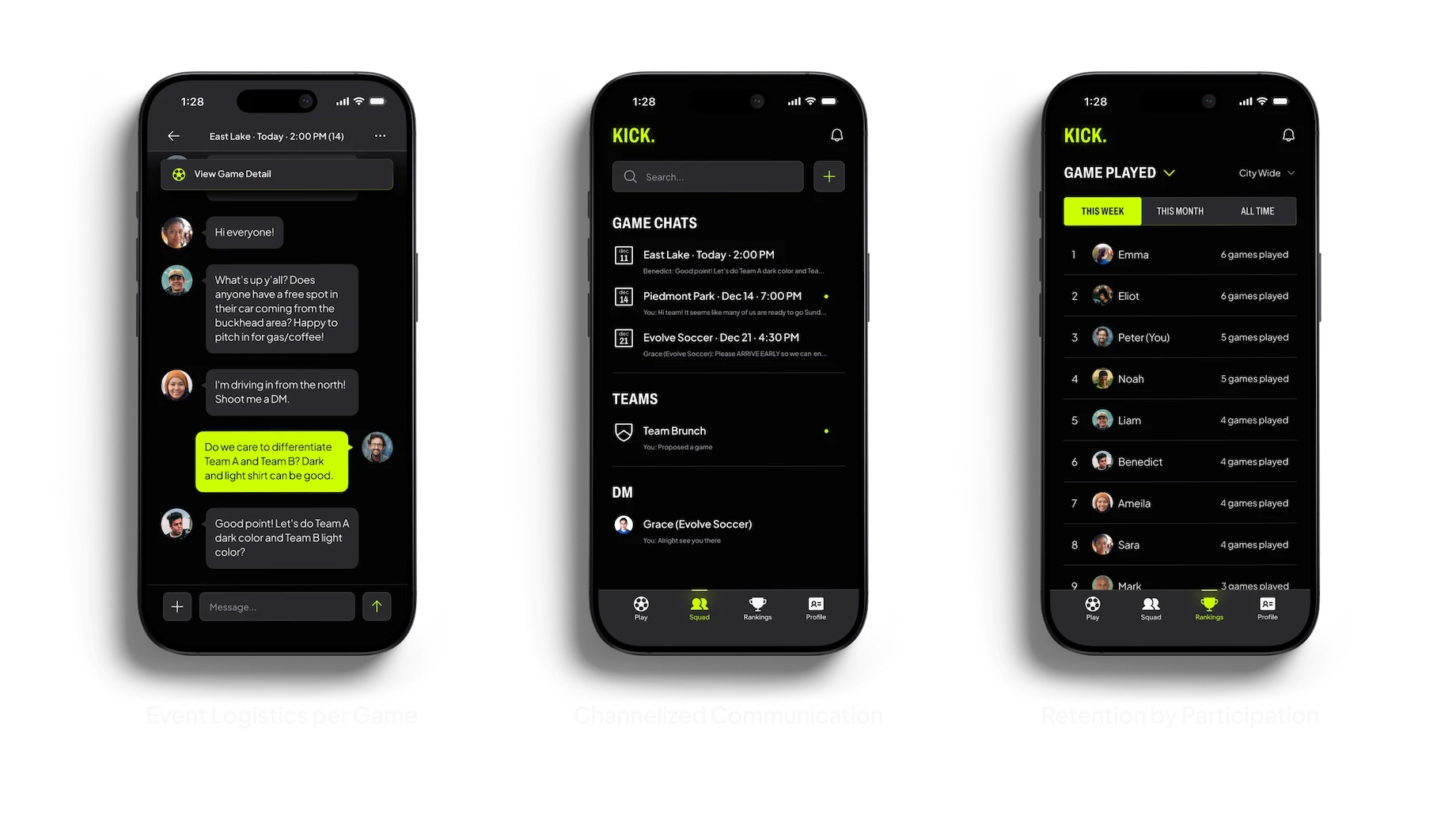
Social Engine: Connection & Consistency
To foster community without clutter, we unified all communication into a single Squad Tab that channels conversations. This structure separates Game Chats for immediate logistics from Team Lounges for social bonding, ensuring critical updates don't get lost in the noise. We replaced leaderboards emphasizing win/loss with one driven by participation. This shift highlights consistency rather than skill or record, rewarding players simply for showing up.
Design System: Street Energy & Usability
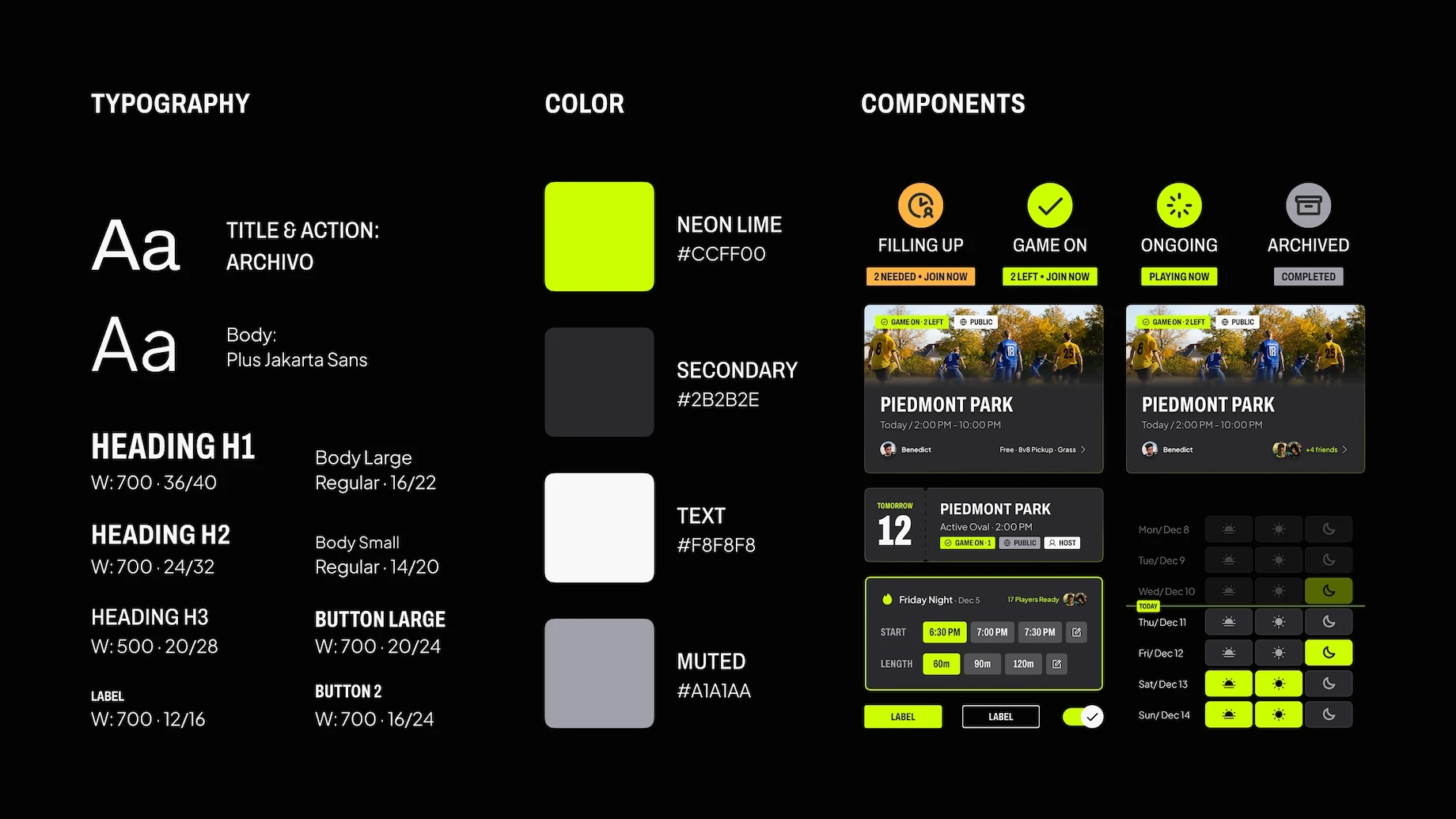
To capture the raw 'street' vibe of pickup, we utilized a Dark Mode foundation. We paired Archivo (All Caps) with Neon Lime to deliver high-energy interaction cues. This intensity is grounded by Plus Jakarta Sans and muted tones, ensuring the experience remains strictly usable without sacrificing its athletic edge.
Impact & Reflection
Validated Success & Handoff
Our prototype achieved a System Usability Scale (SUS) score of 83.70 (Grade A), validating the usability of the new scheduling architecture. Following a technical viability review by software engineers at U.S. Soccer, the design system was approved and handed off for development to support their national soccer engagement strategy.
The Social Heuristic
We initially designed for utility (Price/Location) like other booking platforms. As we transitioned from competitive to social structure, I learned a lesson much bigger this project: Content can be secondary to connection. Whether it's a digital post or a physical game, the primary driver of engagement isn't what is happening, but who is involved. Shifting my mental model from 'transactional' to 'relational' was the key to unlocking retention.
Minimizing Data Copies
Designing the Play Windows taught me the power of data leverage. Instead of asking users to input data for every interaction, we created a single source of truth that powers three distinct features: Discovery filtering, Match proposals, and Team availability. The best systems don't just minimize friction; they maximize the utility of every single user input.
Credit
Team Member
Riley Liu, Raj Sureka, Emily Jeong
External Partner
U.S. Soccer
Special Thanks
Marc Henry Ibeneme, RJ Sajjan, Dr. Carrie Bruce, Dr. Lynn Dombrowski, and everyone participated in our research and evaluation effort.